
“Write more, and your thinking will become clearer.” We hear this often. But when we say writing helps, are we talking about mood, memory, reasoning, or test performance?
Writing tasks in research vary widely: some people write about their feelings, some explain concepts from class, and others revise arguments based on evidence. To understand what writing can do, we first need to look at what participants were asked to write and what researchers measured afterward.
Start with this table: how much evidence supports each benefit?
This article reviews five studies on expressive writing, working memory, critical thinking, and learning. It’s a literature guide focused on these topics, not a review of all writing research, and it doesn’t measure the effects of using Gaoding.
| Area | Writing task | Study scope | What the findings support | Important caveats | Study |
|---|---|---|---|---|---|
| Mental well-being | Expressive writing | 31 randomized controlled studies; n = 4,012 | Small combined improvement in symptoms, g = −0.12 | Benefits aren’t guaranteed for individuals; this isn’t evidence of the effects of general journaling or Gaoding | S1 |
| Analysis and reasoning | Analytical writing with feedback and revision | 310 people; quasi-experimental study | Average CCTST scores increased; some subscales improved | Compared existing classes; teachers and other parts of the intervention may have had an effect | S3 |
| Subject learning | Writing about course content | 56 experimental/quasi-experimental studies; grades 1–12 | Average effect size 0.30 | This doesn’t mean scores went up by 30% or that grades are guaranteed to improve over a semester | S2 |
| Working memory | Specific emotional writing tasks | Two experiments with university students; small samples | Some working memory performance improved | Can’t infer that general intelligence or IQ increases | S4 |
| Comprehension and recall | Active recall using paragraphs or concept maps | Two experiments | Both forms of retrieval outperformed additional study | Can’t attribute the effect to writing alone; this isn’t evidence for AI ghostwriting | S5 |
| General intelligence / IQ | This article found no direct results to support this | The studies above did not directly prove this | We can’t conclude that “writing boosts IQ” | Don’t conflate memory or classroom performance with improved intelligence | S4 |
Psychological well-being: small average improvements, which may not appear right away
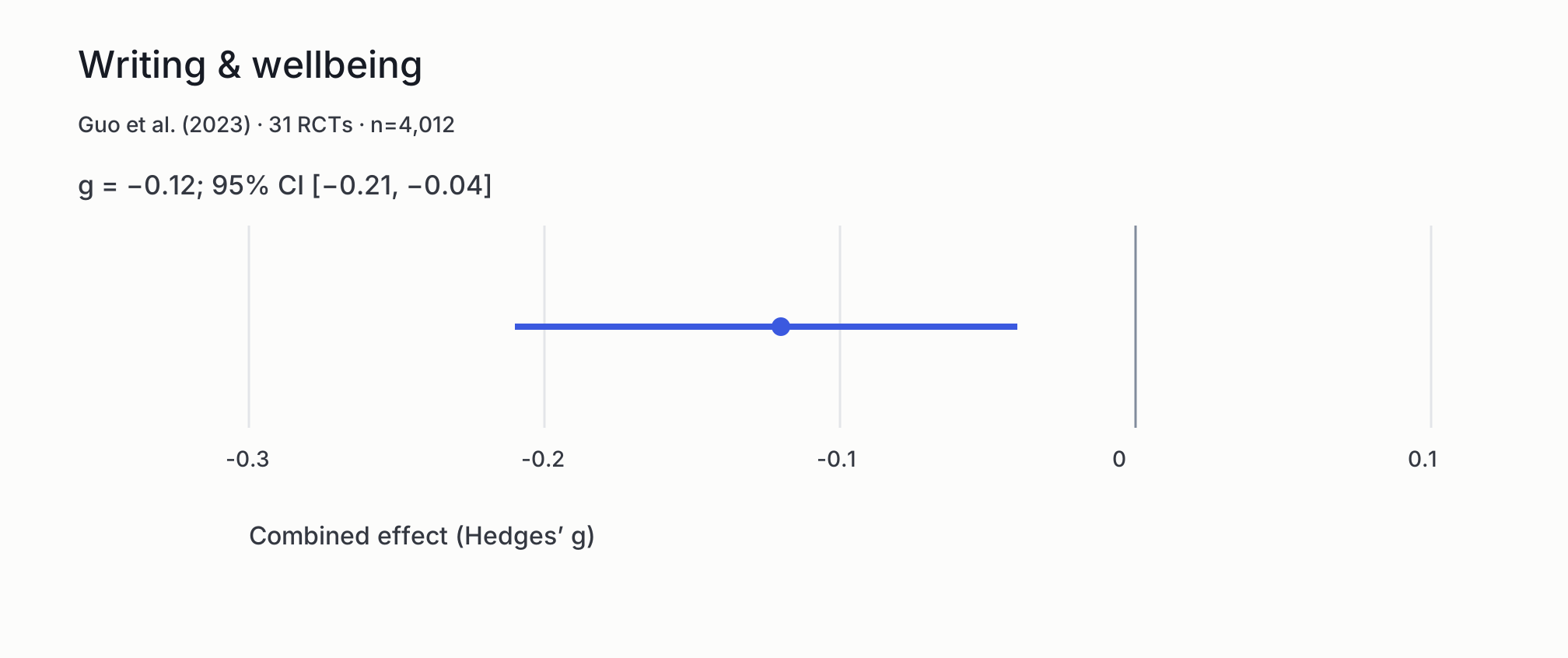
A meta-analysis published by Guo in 2023 included 31 randomized controlled trials with a total of 4,012 participants from healthy and subclinical populations. For expressive writing about emotions, the combined results for symptoms of depression, anxiety, and stress showed a small average improvement: Hedges’ g = −0.12, with a 95% confidence interval from −0.21 to −0.04.
Here, negative values mean fewer symptoms—not worse mental health. They also don’t mean that anxiety fell by 12%. The analysis found that some effects emerged only at follow-up. The research doesn’t guarantee that everyone will benefit, or show that journaling can replace psychotherapy.
Thinking and reasoning: research on analytical writing, with results shaped by how it’s taught
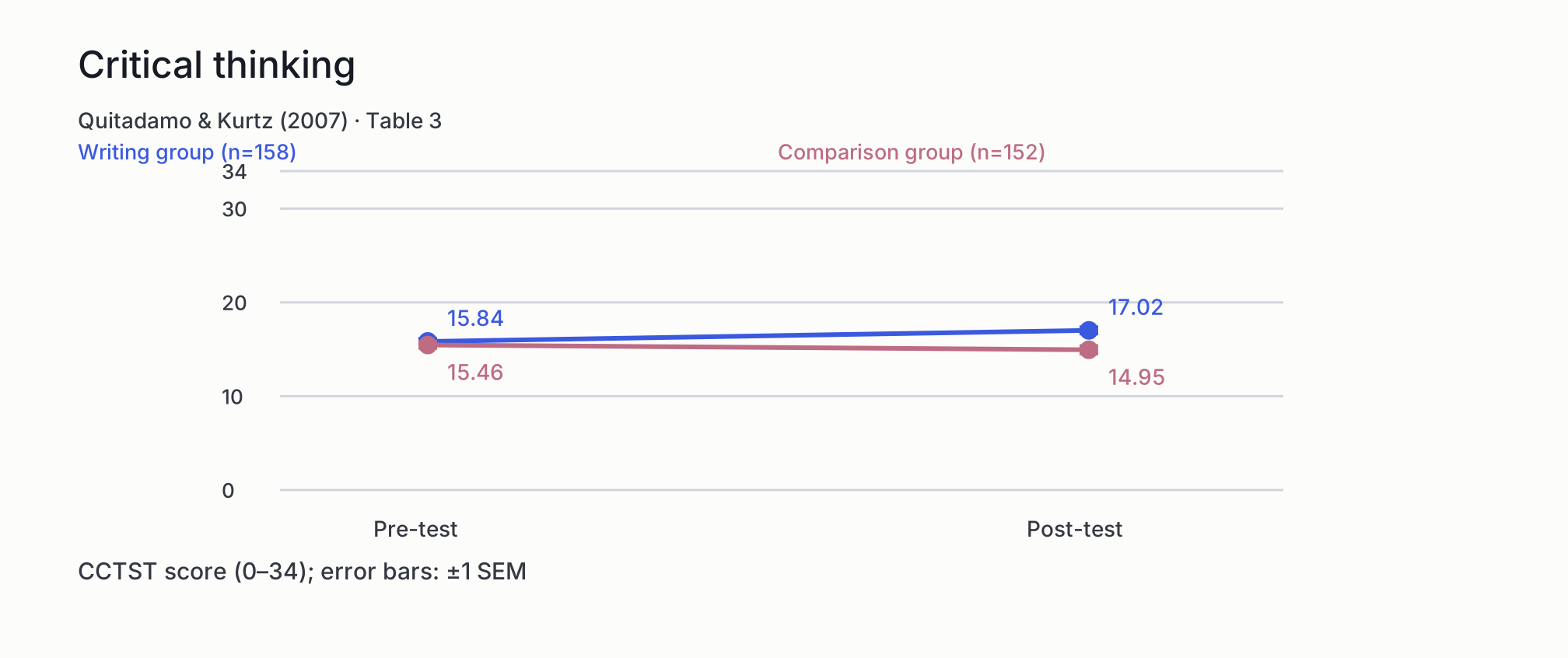
In 2007, Quitadamo and Kurtz studied 310 students in an introductory biology course. In the writing group, which included analytical essays, feedback, and revision, average CCTST critical-thinking test scores rose from 15.84 to 17.02. In the comparison group, scores changed from 15.46 to 14.95.
The study also found improvements in analysis and inference, while the improvement in evaluation was not statistically significant. However, it compared existing classes rather than randomly assigning students, and factors such as the instructor may have influenced the results. A useful writing exercise to take from this study is to state a claim, explain the evidence, and revise it after getting feedback. These numbers shouldn’t be treated as the expected improvement for anyone who keeps a journal.
Quitadamo, I. J., & Kurtz, M. J.(2007)
Learning and grades: more direct evidence for understanding subject matter
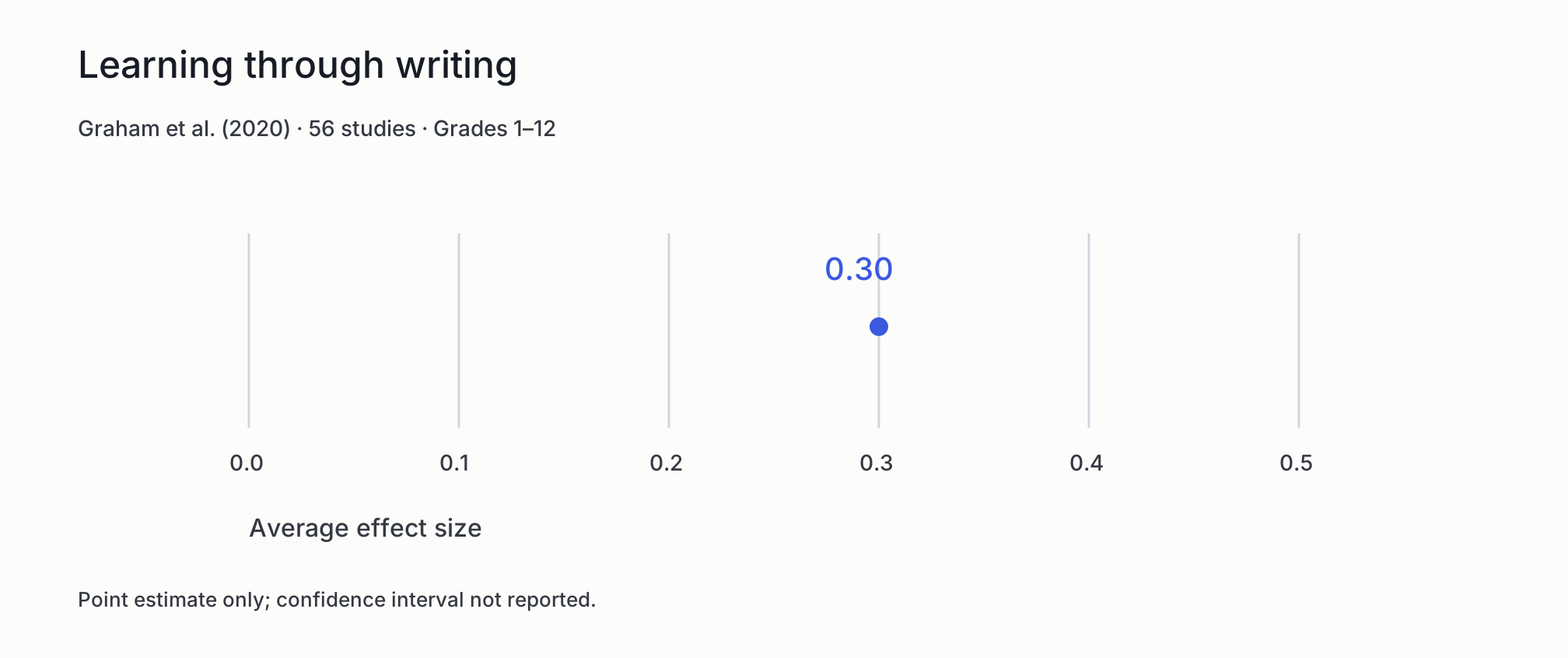
In 2020, Graham, Kiuhara, and MacKay synthesized 56 experiments or quasi-experiments with pretests, involving students in grades 1 through 12. Integrating writing into science, social studies, and math instruction had an average effect size of 0.30 on content learning.
This figure represents a standardized difference across studies. It can’t be converted into a 30% increase on a test, or mean that writing one essay will earn you a few extra points. The study eligibility criteria also excluded research that measured learning outcomes using letter grades. So the findings support learning subject matter; they don’t directly guarantee higher overall course grades.
To apply this approach to your own studying, try writing out the reasoning behind a problem, comparing two concepts, or explaining something you’ve just learned to someone who hasn’t read about it. These are practice suggestions based on the research; you’ll still need to adapt them to your course and get feedback.
Graham, S., Kiuhara, S. A., & MacKay, M.(2020)
Memory and “getting smarter”: distinguish working memory, comprehension, and IQ
In two experiments with college students in 2001, Klein and Boals observed improvements in working memory after a specific emotional writing task. The two groups in the first experiment had 35 and 36 participants, respectively, making this a small sample. Improvement on a working-memory task is not the same as an increase in general intelligence or IQ.
Another important distinction is whether you actually retrieve information from memory. In an experiment published in 2014, Blunt and Karpicke asked participants to recall information using either paragraphs or concept maps. Both retrieval formats led to better test performance one week later than additional study, with no difference between the two retrieval formats. This suggests that the benefit may come from the process of recall—not writing itself.
The research reviewed here doesn’t support the conclusion that “writing boosts IQ.” A more evidence-based way to put it is that specific writing and recall tasks can help with certain measures of cognition and learning.
Klein, K., & Boals, A.(2001);Blunt, J. R., & Karpicke, J. D.(2014)
Try these three writing tasks to make writing work for you
Start with the one you need today; there’s no need to do all three at once:
- Sort through emotions: Write what happened today, how you felt, and what worries you haven’t been able to put into words. If writing makes you uncomfortable, you can stop.
- Process information: Put your materials away for now. Write down three key points from memory, then check and revise them.
- Practice reasoning: Write one claim, one reason to support it, and one possible counterargument.
These everyday writing exercises are suggestions drawn from the research; they haven’t been tested as a complete program. The studies differed in participants, timelines, and tasks, so their effects can’t simply be added together.
AI can help by asking questions, pointing out unclear wording, or assisting with revisions. However, the studies above didn’t test having generative AI replace the writer’s thinking and writing, so they can’t support claims that AI-written work offers the same benefits. When using Gaoding, start by capturing your own understanding, then bring AI in to help with revisions.
Writing gives you a chance to pause, recall, explain, and revise. That process is what’s worth practicing.
References
References checked on 2026 10 22. Charts redrawn using verified figures; they are not images from the original papers. This article introduces selected research and does not cover all writing studies.
- S1 · Guo, L. (2023). The delayed, durable effect of expressive writing on depression, anxiety and stress: A meta-analytic review of studies with long-term follow-ups. British Journal of Clinical Psychology, 62(1), 272–297.DOI: 10.1111/bjc.12408
- S2 · Graham, S., Kiuhara, S. A., & MacKay, M. (2020). The Effects of Writing on Learning in Science, Social Studies, and Mathematics: A Meta-Analysis. Review of Educational Research, 90(2), 179–226.DOI: 10.3102/0034654320914744
- S3 · Quitadamo, I. J., & Kurtz, M. J. (2007). Learning to Improve: Using Writing to Increase Critical Thinking Performance in General Education Biology. CBE—Life Sciences Education, 6(2), 140–154.DOI: 10.1187/cbe.06-11-0203
- S4 · Klein, K., & Boals, A. (2001). Expressive writing can increase working memory capacity. Journal of Experimental Psychology: General, 130(3), 520–533.DOI: 10.1037//0096-3445.130.3.520
- S5 · Blunt, J. R., & Karpicke, J. D. (2014). Learning with retrieval-based concept mapping. Journal of Educational Psychology, 106(3), 849–858.DOI: 10.1037/a0035934
The example in this article is for editorial illustration only; it does not represent actual results from speech recognition or model rewriting. The content was drafted and organized with AI assistance. For information about features and data handling, see FAQs。